Golf Green SpeedReader: Calculating distance
The Goal: Adjusting for different distances
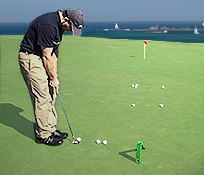 Distance of the putt is the next variable to adjust for after considering the speed differential of the measured green to our standardized "reference speed."
Distance is very important. The longer the putt travels on a specified green speed, the longer it is affected by that speed. Thus, larger adjustments are required from our standardized putting stroke for longer putts than for shorter putts.
How to do it: Calculating in distance
 When we developed our standardized putting stroke using the golf drills, we generally practiced putting a distance of 12 feet.
Since successful putters have a backswing and follow-through of equal length, during the drills, note the length of the backswing you used to create a putt that rolls 12 feet.
Using this knowledge, it is possible to determine how far the length of the backswing must be for a given distance and how much it should be adjusted to putt another distance.
For example, if the backswing length we used in our putting drills to develop our standardized putting stroke for a 12 foot putt is 9 inches back, and we have an 18 foot putt on a green that is the same speed, the required backswing has to be more than 9 inches (probably closer to 14 inches) to accurately match that distance.
NOTE: The length of each backswing varies between individuals and personal styles.
Putting it together: Combining speed and distance adjustments
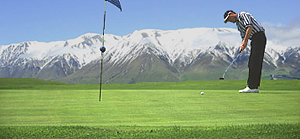 First calculate the speed differential and the amount the stroke should change from the standardized putting stroke.
Next, adjust the backswing length for any distance other than the standard 12-foot putt.
Finally, combine the calculations to create a putting stroke that compensates for both the current lie (distance) and green speed.
The final adjustment to learn how to compensate for is the slope of a golf green.


