One of the keys to effective lag putting is a good read with proper speed. That's particularly true on a big breaker. What good does it do me to get the ball rolling on the correct line if I knock it six feet past the hole? The reason I focus on the speed of a putt is because speed determines line.
I've always been pretty good at reading greens. Wish I could say the same about my speed. When I was younger, I tried to take as much break out of a putt as possible. Sometimes that tactic meant a long comebacker, which more often than not I'd ram into the back of the cup.
Tour greens running 12 or more on the Stimpmeter are a lot more challenging. You must be able to die the ball at the hole on a severely breaking putt, because you're putting to a spot and letting gravity take the ball toward the hole. If it's rolling too fast or slow, you've got no shot at getting it to stop within kick-in range.
On big breakers, speed trumps line - Putting - Brief Article
When you combine the severe green contours at Augusta National with their off-the-chart quickness, a unique spectacle comes into play. You see guys stroking putts with their backs turned to the hole, on the 14th and 16th greens especially. I'm still amazed that Tiger Woods in 1997 and Jose Maria Olazabal in 1999 went 72 holes without three-putting once.
The key to handling sweeping sidehill breaks on fast greens is to focus more on speed than line. Why? If you misread the line by three feet but get the speed right, you'll have three feet left for your second putt. But if you misjudge the speed by three feet, you might have 10 feet or more left for your second putt. If the ball is going too fast or slow when it "takes the break," all bets are off. On breaking putts, speed kills.

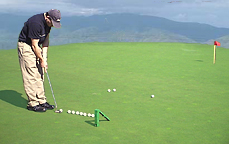 Many people believe that we determine the line then choose the speed to use. This is absolutely incorrect as the speed of the putt determines the line to use. Know the correct speed and the line is much easier to read.
 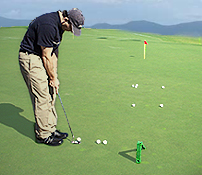 Adjusting for the slope on the green is the last variable to adjust for after adjusting for speed and distance differences from our reference speed.

